




8 mins read
By John Thwaites, Founder, GoReinvent
Some people describe it as losing their passion permanently. Others say they’re exhausted in a way they can’t explain to anyone who hasn’t been there. Others are searching for jobs at midnight, not because they want a new job, but because they don’t want to face Monday morning.
If you’re experiencing burnout after 50, this article is for you. Not to inspire you or tell you it all works out. But to show you what burnout at this time of life is actually telling you, because it’s telling you something specific, and most people miss it completely.
Why Burnout After 50 Doesn’t Respond to the Usual Fixes

There are two different things that get called burnout.
The first is overload: too much on, for too long. The fix is genuine rest, a reduction in pressure, and time. You come back and the work’s still there, still meaningful, still capable of giving something back. You are just tired inside a system that still works.
The second is different. The system itself has stopped working. You aren’t tired inside it. You’re tired of it. And no amount of rest changes the nature of the system.
At age fifty, fifty-five, sixty, it’s more often the second kind.
Burnout after 50 is a form of chronic work-related exhaustion caused not just by overload, but by a mismatch between your skills, identity, and the work you’re doing.
Call it occupational burnout in its deeper form: the kind that doesn’t respond to rest because the work itself has become the wrong fit, not just an overload.
The World Health Organisation defines burnout as “something caused by the work environment, not a personal failure. A syndrome caused by chronic workplace stress that has not been successfully managed. Not a weakness. Not a character flaw. A problem in how work is set up.”
If the problem is in how the work is set up, the solution also must be in how the work is set up. A holiday does not fix that. Neither does talking to your manager.
In some cases, what looks like burnout may overlap with other factors including questions around menopause and what’s really happening underneath.
How Burnout Builds Over Time
Burnout at this stage doesn’t arrive suddenly. It builds. And the sequence it follows is recognisable.
It starts with a stable period. The work producing enough, financially, in terms of identity, in terms of daily satisfaction, to make the effort feel worthwhile. Then friction begins to build. Not dramatically. A slow accumulation of days where what the work costs you, and what it gives back, are no longer in balance. Where what you value and what you actually spend your hours doing are persistently, stubbornly out of step.
Then comes the coping phase. Pushing through. Reducing effort in the areas that drain you the most. Detaching, slightly, from things that once mattered. This can last years. From the outside, and often from the inside, it looks like a sustainable arrangement.
It’s not. And the body tends to know this before the mind is ready to admit.
For a more detailed look at how this actually shows up, you can explore how midlife burnout plays out in practice in the UK.
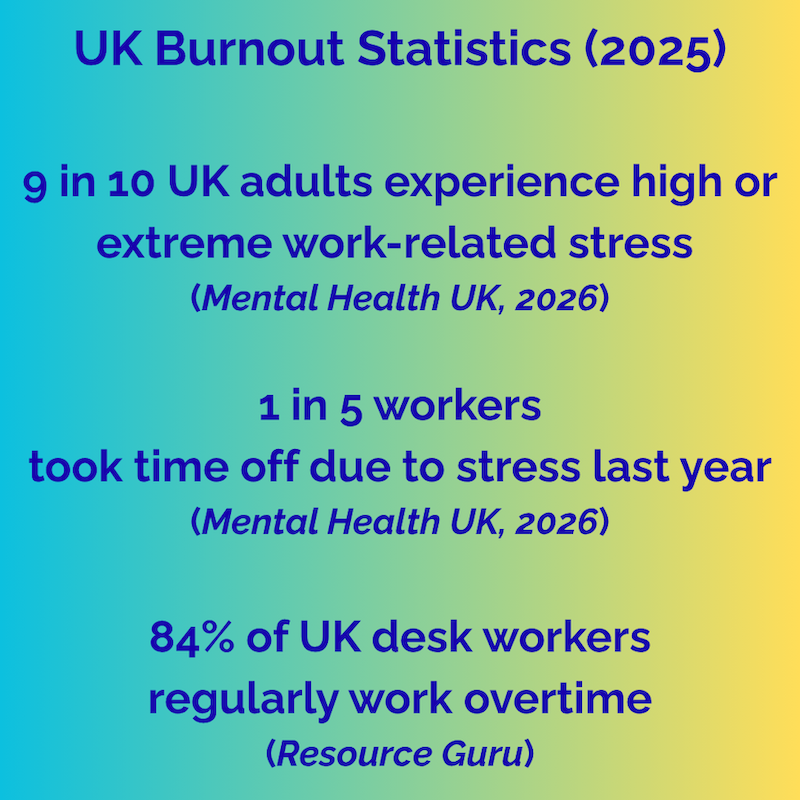
Mental Health UK’s most recent burnout research found that nine in ten UK adults are experiencing high or extreme levels of work-related pressure or stress. One in five workers took time off last year due to stress-related poor mental health. A separate study of UK desk workers found that 84% regularly work overtime and 68% work weekends, with chronic overwork linked directly to burnout, anxiety, and physical health symptoms.
These aren’t one-offs, they’re the norm. The work is extracting more than most people can sustainably give. And for people in their fifties who’ve been giving at that rate for decades, the account is often closer to empty than they realise, until something forces the reckoning.
“I can’t imagine doing this for another ten years.”
That thought, half resignation, half alarm, is one of the most common things people in this position report. Not said out loud, usually. Just present. Surfacing at intervals and then pushed back down because there’s no obvious answer.
Eventually the label appears: Burnout, Exhaustion. “I’ve just lost the passion for it, I think. Permanently.” And underneath the depletion, something else begins: a questioning that has no obvious answer. The kind that surfaces on Sunday evenings when the week ahead is already pressing.
Burnout at this stage is rarely caused by one thing. For most people it’s a combination: too much of what drains you, too little of what you are actually good at, and a growing awareness that the gap between the two is not going to close on its own.
A 2025 CIPD survey of over 5,000 UK workers found that 37% of people over 55 reported having skills suitable for a more demanding role, but could see no path to use them. Nearly four in ten people. Doing less than they are capable of, inside a job description that isn’t going to change to accommodate them.
That’s where this becomes real because burnout that comes only from overload can sometimes be fixed by reducing the load. Burnout that comes from overload combined with mismatched work needs a different fix.
Three Assumptions That Keep People Stuck
When burnout hits, people tend to reach for one of three explanations. All of them are understandable, although none of them is quite right.
Retraining from scratch. It’s easy to assume that burnout means you’re missing something, that if you could just acquire new skills, the problem would resolve. Most people in this position assume they need to retrain from scratch. That would make this a skills problem. It usually isn’t. You have skills. The issue isn’t what you know, instead it’s where that knowledge is currently being applied, and in what kind of framework.
Scaling back ambitions. It’s tempting to conclude that the answer is to want less, be more realistic, expect less from work. For some people, at certain moments, there’s wisdom in that. But for most people at this stage, less ambition doesn’t produce more peace; it deepens the slow narrowing that was already setting in.
Early retirement. Which is the right answer for some. But for most people, stepping fully away from meaningful work doesn’t resolve the underlying mismatch. It removes something without replacing it. And that, for most people, accelerates their loss of identity, rather than restoring it.
These are not wrong paths. They’re just imprecise and they treat the symptom without asking how to fix the root cause.
There’s an assumption underneath all of this: that any change means going out on your own and taking a financial risk you can’t afford. That leaving your job means giving up your current income before anything else is working. This stops more people than anything else. But the paths that actually work at this stage do not begin with a leap. They begin small.
Because the real fear isn’t change, it’s losing financial security before anything else is reliably bringing in income.
Which raises the question: if it isn’t about skills, not about retirement, and not about quitting outright, what does making a change from here actually require?
The Reframe That Changes What Comes Next
Burnout isn’t the problem; it’s a signal.
It’s pointing at a sustained mismatch between what you’ve been doing and what is actually available to you now, in terms of your skills, your energy, your identity, and the market around you. It’s the moment the gap between those things becomes impossible to close by working harder, resting longer, or adjusting your attitude.
The question isn’t: how do I recover?
The question is: what’s this pointing to?
That shift, from recovery to navigation, is the difference between treating a symptom and reading a sign. It’s also, in practice, the difference between what the two people below did, and what most people are advised to do.
Real Examples of Burnout After 50.
Two People, Very Different Situations. The Same Underlying Pattern.
Mike Bramhall, Schoolteacher
Mike taught for years inside a system that had, over time, become almost entirely about the system itself: the paperwork, the targets, the accountability structures that multiplied every year. He was working harder than he had ever worked, and getting less back than he ever had.
His children were growing up. He was missing it. Not through lack of care, but through lack of time and energy. By the time he got home, there wasn’t much left of him to give.
The turning point was not a decision, it was physical collapse. The stress had been accumulating for long enough that his body made the call his mind kept deferring.
In the period that followed, he made a shift. He had a choir: fifteen people, a community hall, Tuesday evenings. A hobby he had been told throughout his life had no commercial value. But it was the one part of his week where he felt like himself, where the thing he was actually good at, bringing people together and creating a space where they felt capable of something, was operating without institutional weight pressing down on it.
That recognition changed everything. What the choir was doing, building a community around a recurring experience that people valued enough to keep returning to, required a specific set of skills. Identifying the right people, creating belonging, delivering something consistently, making it visible to the right people and giving them a reason to come back. These weren’t music skills, they were business skills that happened to be expressed through music.
Mike applied them deliberately. One choir became two. Then more. A subscription model, monthly and quarterly payments, online and in person. Over time, that pattern compounded. By 2026, Mike had fourteen choirs and more than 2,000 paying members, and the number is still climbing.

What he recognised was not “I love music, therefore music is a business.” It was something more useful than that: I am skilled at building communities of people around a shared experience, and people will pay regularly for that.
Skills first. His passion was the context.
Read Mike’s story here.
Melissa Robinson, Mortgage Broker
Melissa ran a mortgage brokerage in New Zealand for seven years. Successful, by any external measure. She was also working sixty-hour weeks, carrying responsibility for a team of employees, managing a business partnership, and absorbing the daily weight of other people’s biggest financial decisions.
The hours were one thing. The responsibility was another. When you are the person that staff depend on, clients trust, and a business partner relies on, there is no clean end to the working day. The stress never fully stops. The account empties faster than it refills.
The question that eventually forced itself was simple: what do I want the rest of my life to look like?
The honest answer was: not this.
She left the business and then she had to work out what to do with what she had, which turned out to be considerable. Seven years of building trust with people making some of the biggest financial decisions of their lives. The ability to take something complex and explain it in plain language. The patience and skill to help someone who is uncertain arrive at a confident decision.
None of that required a brokerage to function.
She moved into affiliate marketing. The first few months were difficult. Ten or fifteen ads that didn’t work. Messaging that didn’t connect. Going back through training she’d rushed the first time. The breakthrough came when she stopped presenting information and started telling her own story, the burnout, the decision to leave, the uncertainty of what came next, the gradual building of something different.

Affiliate marketing, at its core, is this: you help someone who’s uncertain make a confident decision about something that’s genuinely useful to them, and you’re paid when they do. That is precisely what a good mortgage broker does. The product was different. The persuasion structure, the trust-building, the ability to meet someone where they are and walk them toward clarity, that was identical.
The skill that had made her a good mortgage broker, sitting with someone who is uncertain, helping them think clearly, earning their trust over time, turned out to be exactly the skill that made her a good marketer.
Within her first year, the income followed. Enough to make the shift sustainable: working less, not stressed, spending more time with family across three continents.
Same skills. Different model.
Read Melissa’s story here.
What Mike and Melissa Actually Have in Common
Not all paths look like these two. Some are slower. Some involve less dramatic outcomes. That isn’t the point.
The point is what sits underneath both of them, because that’s what’s relevant here.
Movement started before clarity arrived. Neither Mike nor Melissa had a complete picture before they took their first step. The clarity came from moving, not from waiting until the path was fully visible.
The first move was small and reversible. A Tuesday evening choir. An online course. Something that could be undone if it did not work. Neither of them staked everything on a single decision.
The income shift was gradual, not instant. There was a period of building before there was a period of earning. This is almost always true, and expecting otherwise is one of the main things that stops people starting.
Identity lagged behind the behaviour. Both of them were doing the new thing before they felt like a new person. The feeling of being a different kind of worker came after the doing of it, not before.
The exploration was private at first. Low-risk. Not a public commitment or a financial bet. An experiment, taken seriously.
What Income Models Work After 50
This part of the conversation can easily tip into false reassurance, the idea that being over 50 is secretly an advantage that younger people cannot access. That framing is wrong because it feels like something said by someone who needs you to feel better, rather than someone telling you the truth.
So here is what’s actually true:
At this stage, the problem is rarely capability. It’s where and how your capability is being deployed.
The skills built over decades. The relationships. The judgement that comes from having made significant mistakes and recovered from them. The professional credibility that doesn’t need to be claimed because it’s simply present in how you operate.
None of that disappears with burnout. What has to change is the model you’re applying yourself through.
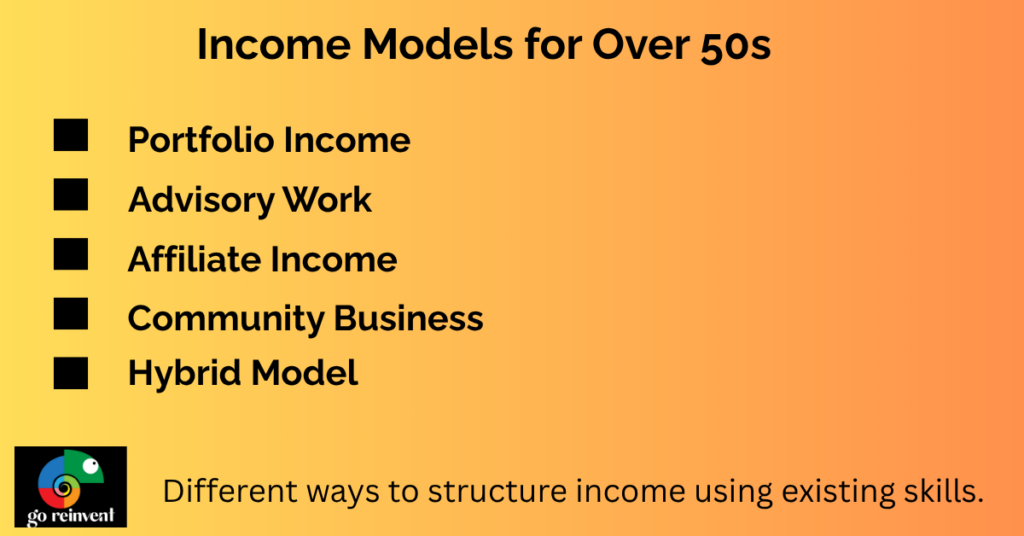
There are more income models available now than most people in this position realise. Portfolio income. Advisory arrangements. Affiliate structures. Community-based businesses. Hybrid models that combine several of these, and more. The question isn’t what can you do. It’s which model fits what you already have, who you already are.
That’s a different question. And it tends to produce different answers.
One more thing worth saying. Exploring that question doesn’t require you to quit your current role before you’re ready. It doesn’t require a public announcement, a business plan, or taking a financial risk you can’t afford. Mike ran a choir on Tuesday evenings for years before it became a business. Melissa completed an online course while she was still working out what came next. The exploration happens at whatever pace fits your life. The only thing it requires at the outset is a willingness to look honestly at what you have, and what income model might fit better than the one you’re currently in.
What GoReinvent Focuses On
This is the space GoReinvent focuses on, helping people over 50 identify what they have: skills, experience, knowledge, relationships, and find income models that fit where they are now, not where they were twenty years ago.
The platform was built by someone who went through his own version of this. A business collapse in his early sixties that forced an honest mapping of what remained and what was actually available.
It isn’t a recruitment agency. It’s not a retraining programme. It’s a way of identifying the mismatch and finding a model that fits what you already have and how you now want to work.
This is part of a broader shift in how work is breaking down and why GoReinvent was created in the first place.
Why Burnout After 50 Doesn’t Go Away on Its Own
Most people in this situation wait. They assume it will pass, that an easier stretch at work, a good holiday, a change in management will shift things enough to make work bearable again.
Sometimes. More often, not. And the waiting has a cost that is easy to underestimate.
Mismatch compounds. The longer the gap between what the work is taking and what it is giving back, the harder it becomes to see clearly what you actually have and what you might do with it. Exhaustion narrows vision. A person who is depleted has a smaller sense of their own options than the same person with some energy and space to think. Waiting for the right moment to look honestly at your situation is often how people arrive at a moment of forced decision, redundancy, health, restructuring, with less clarity and fewer options than they would have had two or three years earlier.
Waiting is itself a decision with consequences.

The Question You Need To Answer
Most articles end with an instruction. A reason to act. A next step delivered with urgency.
This isn’t that moment.
If something in this resonates, the most useful thing you can do is not to act immediately. It’s to sit with this question.
What is this pointing to?
Not what should you do. Not what would look sensible from the outside. Not what you are supposed to want at this stage of life.
What is the burnout and the slow narrowing of options pointing to?
That question, taken seriously and given time, tends to produce a clearer answer than any list of options or next steps.
If you’re finding it hard to see what your options actually are, this guide is a reasonable place to start: Why You Can’t See Your Work & Income Options
Frequently Asked Questions
What are the signs of burnout at work?
The signs are not always dramatic. They tend to be more subtle than people expect. A persistent inability to relax when you’re not working. A slow loss of interest in things that once mattered. Going through the motions competently but feeling detached. Irritability that surprises you. A sense that you’ve lost yourself somewhere in the years of keeping things going. Physically, chronic overwork has been linked directly to poor sleep, lowered immunity, and in more serious cases, the kind of exhaustion that stops you functioning. If rest is no longer restoring you, that is a sign worth taking seriously.
How long does burnout take to recover from?
The honest answer is that it depends on what kind of burnout you have. Burnout caused by overload, too much on for too long, can improve significantly with genuine rest and a reduction in pressure. But burnout that comes from a sustained mismatch between what the work is asking of you and what you are actually capable of and interested in tends not to resolve with rest alone. The work itself needs to change, not just the load. For people in their fifties who have been running on empty for years, recovery in the conventional sense may not be the right frame. The more useful question is: what is this pointing to, and what needs to change about the work itself?
What should I do if I am burnt out at work?
The standard advice, take a break, talk to your manager, set better boundaries, is designed for overload burnout, and it is genuinely useful for that. If it has not worked for you, or if it seems disconnected from your actual situation, that is worth paying attention to. It may be telling you that what you are dealing with is not primarily an overload problem. The more productive question at that point is not how to recover but what the burnout is pointing to, specifically whether there is a mismatch between the work you are doing and the skills, energy and identity you actually have available now. That question tends to produce more useful answers than any list of coping strategies.
Does burnout go away on its own?
Sometimes, if the cause is temporary overload and the conditions change. More often, particularly at this stage of a career, it does not, because the conditions do not change. And waiting for them to change has a cost that is easy to underestimate. Exhaustion narrows your sense of what is possible. The longer the gap between what the work is taking and what it is giving back, the harder it becomes to see clearly what you have and what you might do with it differently. Waiting for the right moment to address it is often how people arrive at a forced decision, redundancy, health, restructuring, with less clarity and fewer options than they would have had if they had started looking earlier.
How do I know if I need to change career or just take a break?
The clearest signal is what happens after a break. If rest restores you and you return to work with something approaching your previous energy and engagement, the problem is most likely overload. If rest does not restore you, if you come back from a holiday and within days or weeks the same feeling is back, that is a strong indication that the problem is in the work itself rather than the volume of it. A break addresses the load. It does not address the mismatch. If the mismatch is the underlying issue, a break will give you temporary relief without changing the trajectory. That distinction is worth sitting with honestly before deciding what kind of change is actually needed.
This article was produced by GoReinvent. GoReinvent helps people over fifty explore work and income options outside traditional employment. Nothing in this article constitutes financial advice. Pension decisions should be discussed with a regulated financial adviser before action is taken.
© GoReinvent 2026. All rights reserved.
